
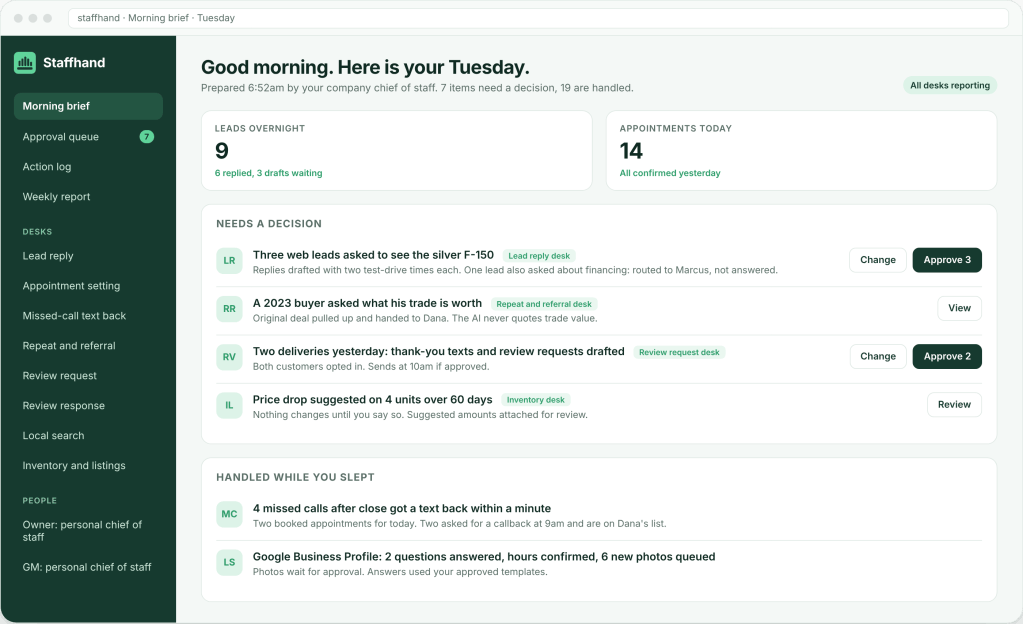
Most owners start the day by opening five tabs and three apps to find out what happened overnight. The morning brief replaces that. It is one short read, delivered before the day starts, written by the company chief of staff from the systems it is connected to.
Every Staffhand build includes one. Here is what is in it, and what one might look like for an independent used-car dealership and a local fitness gym.
The three parts
The brief has the same shape every day.
What came in overnight. Leads, messages, reviews, bookings, missed calls, form submissions, payments or funding items. Whatever the connected systems recorded since the last brief, summarized by source.
What needs a decision. The items waiting in the approval queue, grouped by desk. Drafted replies, posts, review responses, template changes, budget recommendations. Also anything the agents could not handle on their own, including every price, trade value, credit or financing question that was routed to a person and is still waiting on one.
What the agents plan next. What each desk intends to do today: follow-ups scheduled, posts queued, reminders due, reports in progress. The owner sees the plan before it runs and can change it.
Three parts, in that order, every morning. If a desk had a quiet night, it gets one line or none.
Where the information comes from
The brief is not a summary of what the agents did. It is drawn from the business’s own systems: the CRM, the booking tool, the review profiles, the ad accounts, the website analytics, the accounting or billing system where it is connected. The chief of staff reads those and writes the brief.
That matters because it means the owner can ask follow-up questions. A dealership owner can ask the chief of staff about inventory, sales and leads in plain English and get an answer from the dealer’s own system. The brief is the starting point for that conversation, not the end of it.
For a dealership, the brief covers yesterday’s sales, leads and response times, appointments, funding exceptions, aged units, reviews and ad spend. For a gym, the owner’s brief covers calendar, priorities, gym numbers and items waiting for approval.
What a dealership brief looks like
This is the shape of a dealership brief. The bracketed items are where your own numbers go.
Overnight. [Number] new leads: [number] from car sites, [number] from the website, [number] from the Google listing, [number] repeat or referral. First replies drafted for all; [number] approved and sent, [number] waiting. [Number] missed calls after close, all texted back. [Number] new reviews, drafted replies in the queue.
Needs a decision. [Number] lead replies waiting. [Number] review replies waiting. One pricing question from a lead (source: [lead source]), routed to [salesperson], not yet answered. Inventory desk flags [number] units with no description. Funding desk flags [number] deals past [age] waiting on lender.
Planned today. Follow-up lists ready for each salesperson, [number] drafted messages total. [Number] appointments confirmed, reminders sent. Local search desk posts the weekly Google update at [time] pending approval. Social desk has [number] clips queued for approval. Attribution desk delivers the weekly report [day].
What a gym brief looks like
The same shape, for a gym.
Overnight. [Number] intake forms submitted, all confirmed and replied to. [Number] consult bookings. [Number] DM keyword replies sent. [Number] macro calculator reports requested, nurture emails drafted. [Number] new Google reviews, replies drafted.
Needs a decision. [Number] weekly client check-ins drafted by the coaching desk, waiting for coach approval. [Number] review replies waiting. [Number] social posts waiting, including [number] transformation posts with consent on file. Website desk proposes a change to [page], waiting.
Planned today. Follow-up desk sends [number] win-back messages to lapsed members on the approved template. Booking reminders go out for today’s [number] sessions. Social desk has [number] posts scheduled pending approval. Website desk runs the weekly listing and hours check.
The shape is the same. The desks differ because the audit finds different gaps in each business.
What the brief is not
It is not an alert feed. The brief arrives once, in the morning. Urgent items during the day go through the approval queue, which the owner or a named approver checks on their own schedule.
It is not a report of results. The weekly report does that, tied to attribution so marketing spend is connected to leads and sales. The brief is about today.
It is not a log. The live action log records every agent action with a time and is available any time. The brief points to it when something needs a closer look.
For how the queue fits with the brief, see one approval queue: how approval mode works. For the full set of things the owner sees, see how it works.
Personal briefs
Owners and leaders who have a personal chief of staff get their own version. It adds that person’s calendar, priorities and follow-ups to the company picture, and draws on the company chief of staff so the numbers match what the business sees.
Start with a digital audit
The brief is only as good as the systems behind it. The audit tells us which of yours are connected, which are not, and which desks would feed the brief in your business. Start with a digital audit.